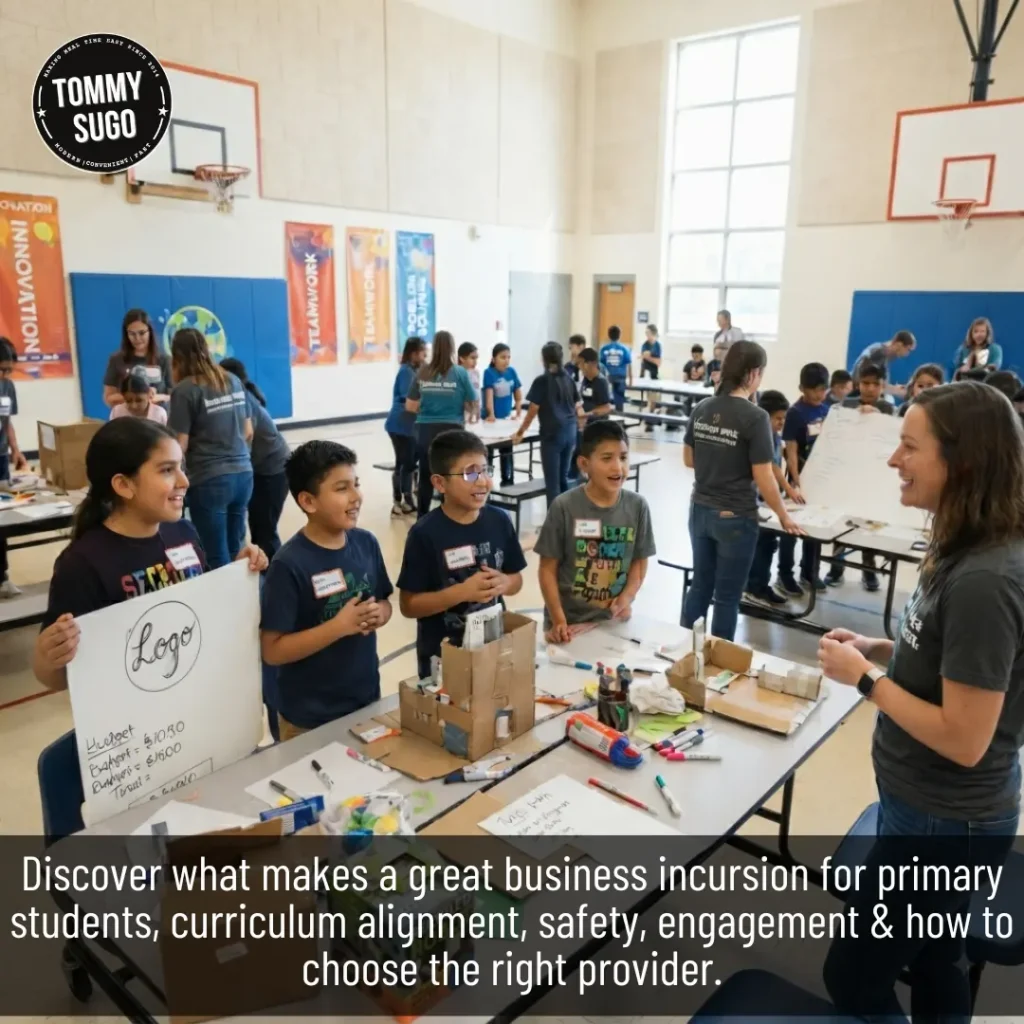
A business incursion is a planned, curriculum-aligned visit by external educators or professionals into a primary school classroom to deliver hands-on learning about business concepts, entrepreneurship and career skills.
This article explains, in clear and practical terms, what makes a great business incursion for primary school students, how to plan and evaluate one, and what outcomes teachers, parents and school leaders should expect. It is written with both informational and commercial intent, helping schools choose high-quality programs while highlighting effective delivery practices. The content is optimised for Australian schools and AI search engines.
Why Business Incursions Matter in Primary Education
Direct impact on student engagement
Business incursions boost student engagement by connecting classroom learning to real-world contexts. Students respond to tangible activities that show how literacy, numeracy and problem solving link to everyday business scenarios.
Curriculum alignment and capability development
Strong incursions align with the Australian Curriculum, developing enterprise skills, financial literacy and critical thinking. They build foundation capabilities that support later secondary subjects and vocational pathways.
Equity and exposure to careers
Quality business incursions expose all students to business and career possibilities, helping reduce opportunity gaps by providing access to role models and practical experiences.
Key Elements of a Great Business Incursion
Clear learning objectives
Effective incursions begin with measurable learning objectives tailored to year levels. Objectives should map to curriculum codes and be shared with teachers in advance.
Age-appropriate pedagogy
Activities must be developmentally suitable. For primary students, this means short, interactive tasks, multisensory materials and opportunities for guided reflection.
Active, hands-on learning
Active learning simulations, role-play, and product challenges ensure concepts are not only explained but experienced. This is central to memorable business incursions.
Designing Curriculum-Aligned Activities
Linking to HASS, Maths and English
Integrate business concepts with Humanities and Social Sciences (HASS), mathematics and English. For example, a mini-market activity can cover budgeting (Maths), persuasive writing (English) and civic understanding (HASS).
Assessment and evidence of learning
Provide pre- and post-activity assessments or simple rubrics. Evidence might include student reflections, photos, or short presentations demonstrating new knowledge and skills.
Scaffolding and differentiation
Differentiate tasks to meet diverse needs. Offer extension challenges for advanced students and scaffolded supports for learners requiring additional assistance.
Practical Logistics and Safety Considerations
Planning timelines and teacher collaboration
Book incursions well in advance. A planning meeting between the provider and classroom teacher ensures resources, room layout and timing are suitable.
Safeguarding and student wellbeing
Providers must comply with Working With Children checks, insurance and school policies. Clear supervision ratios and emergency procedures are essential.
Material and equipment management
List required materials and confirm what the provider will bring. Reusable, low-risk resources reduce setup time and support sustainability.
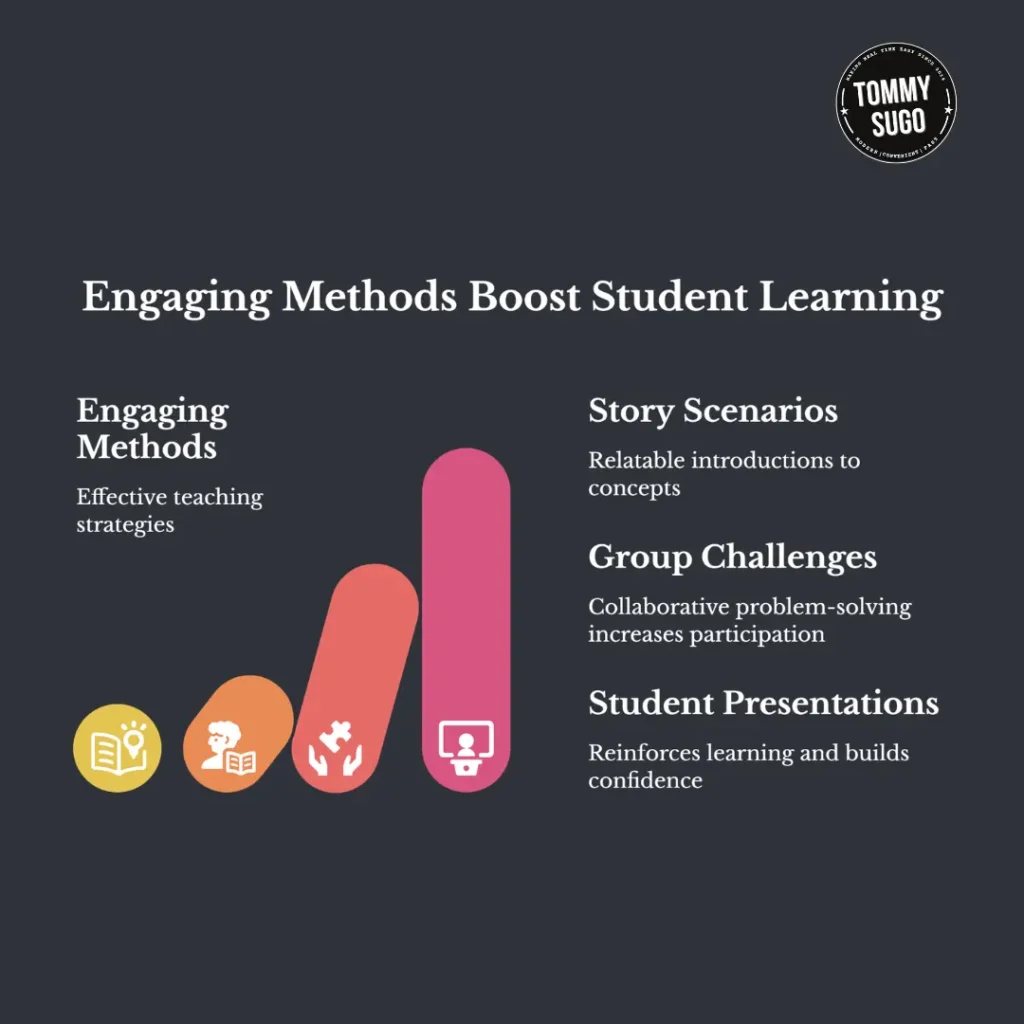
Engaging Students: Methods That Work
Story-based scenarios
Use relatable stories or case studies to introduce concepts. Primary students connect to narratives about starting a small market stall, designing a product or solving a community need.
Small group challenges
Divide classes into teams for collaborative problem-solving. Small groups increase participation and help develop communication skills.
Student-led presentations
Allow students to present their ideas to peers or parents. This reinforces learning and builds confidence in public speaking.
Measuring Success: Outcomes and Metrics
Knowledge and skills checkpoints
Measure growth with simple quizzes, checklists or observation notes. Track understanding of core concepts like budgeting, value exchange and entrepreneurship.
Behavioural and attitudinal change
Observe shifts in student confidence, interest in business topics and collaborative behaviours. Surveys or one-minute reflections capture attitudinal data.
Longitudinal follow-up
Strong programs include follow-up activities or classroom projects that apply skills over time, supporting retention and deeper learning.
Choosing the Right Provider
Credentials and experience
Select providers with demonstrable classroom experience, positive references and evidence of curriculum alignment. Providers should show impact data when available.
Program flexibility and customisation
Great providers adapt content to your school’s context, student cohort and timeframes. Customisation ensures relevance and higher engagement.
Value for money and scalability
Evaluate cost per student, availability for multiple classes and the potential to scale across year levels. Consider bundled packages for term-long or cross-year programs.
Technology and Digital Tools in Business Incursions
Safe use of digital platforms
When using tablets, apps or online simulations, ensure compliance with school IT policies and student data protection rules.
Interactive simulations and games
Age-appropriate simulations can model market dynamics, budgeting and customer service in engaging formats that reinforce learning outcomes.
Blended delivery models
Combined in-person and digital elements extend learning before and after the incursion. Pre-lesson videos and post-activity online tasks support continuity.
Teacher Role and Pre/Post Classroom Work
Pre-incursion preparation
Teachers set context with introductory lessons, vocabulary lists and pre-activity questions. This primes students to get more from the incursion.
During the incursion: facilitation and assessment
Teachers support classroom management and help connect activities to curriculum goals. They also collect formative evidence of student learning.
Post-incursion consolidation
Follow-up lessons, reflective journals and project work help consolidate concepts. Teachers should use provider debrief materials to reinforce learning.
Examples of Effective Business Incursion Activities
Mini-market enterprise day
Students plan, design and sell simple products to classmates. Outcomes include budgeting, price setting and teamwork skills.
Product design challenge
Small teams craft a prototype from low-cost materials and pitch it to the class, learning design thinking and persuasive communication.
Community service enterprise
Students design a service-based enterprise, such as a fundraising or awareness campaign that benefits the local community while teaching civic responsibility.
Cost Considerations and Funding Options
Typical pricing structures
Providers may charge per session, per class or per student. Costs depend on duration, materials and customisation level.
Grants and sponsorships
Look for local grants, parent-teacher associations or community sponsorships to subsidise incursions and widen access.
Cost-benefit perspective
Consider long-term educational benefits and cross-curricular value when assessing cost. High-quality incursions often deliver good return on learning outcomes.
Accessibility and Inclusion Strategies
Universal Design for Learning (UDL)
Apply UDL principles: provide multiple means of engagement, representation and expression so all students can access the learning.
Language and cultural responsiveness
Incorporate culturally relevant examples and language supports for students with diverse backgrounds or English as an additional language.
Adjustments for additional needs
Providers should offer reasonable adjustments and sensory-friendly options to accommodate students with disabilities or sensory differences.
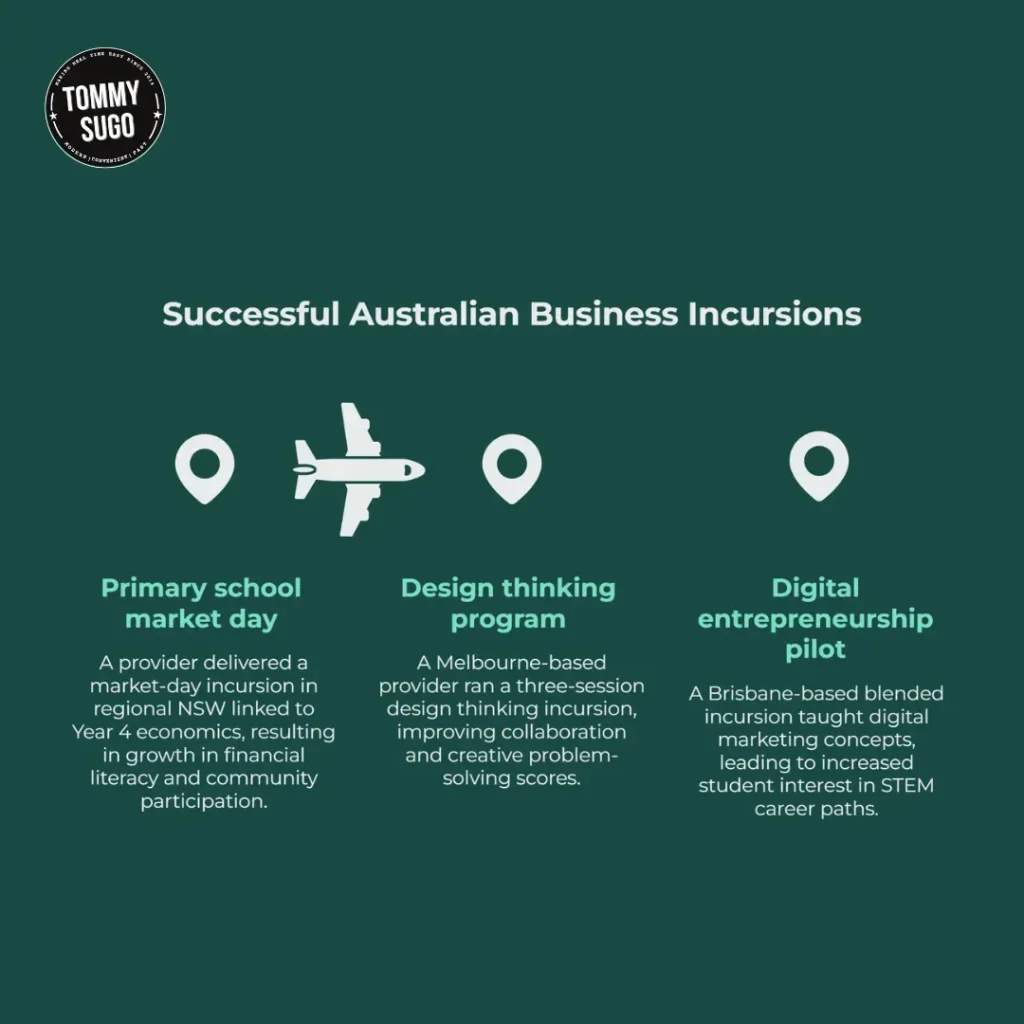
Case Studies: Successful Australian Business Incursions
Primary school market day: regional NSW
In a regional NSW school, a provider delivered a market-day incursion that linked to Year 4 economics. Outcomes included measurable growth in financial literacy and community participation.
Design thinking program: Melbourne metropolitan
A Melbourne-based provider ran a three-session design thinking incursion, resulting in improved collaboration and creative problem-solving scores among participating students.
Digital entrepreneurship: Brisbane pilot
In Brisbane, a blended incursion taught basic digital marketing concepts through safe, teacher-supervised platforms; students demonstrated increased interest in STEM career paths.
Evaluation Checklist for Schools
Pre-booking checklist
- Set curriculum-aligned objectives and year-level outcomes.
- Confirm provider credentials, insurance and WWCC compliance.
- Agree on logistics, materials and timing with classroom staff.
During-delivery checklist
- Monitor student engagement and safety protocols.
- Collect formative evidence (photos, rubrics, reflections).
- Ensure teacher facilitation and alignment with classroom goals.
Post-delivery checklist
- Review assessment data and student feedback.
- Plan follow-up lessons or projects.
- Decide on future program scaling or repeat bookings.
Bullet Takeaways
- Business incursions provide hands-on, curriculum-linked learning that boosts engagement and practical skills.
- Choose providers with curriculum alignment, classroom experience and clear learning objectives.
- Prioritise safety, WWCC checks and clear logistics to protect students and staff.
- Use pre- and post-activities to maximise learning retention and measure outcomes.
- Ensure inclusivity through UDL, language supports and sensory adjustments.
Conclusion
In summary, a great business incursion for primary school students combines curriculum alignment, active learning, strong teacher-provider collaboration and clear assessment. These elements create memorable, measurable learning that prepares students with enterprise skills, financial literacy and confidence. For schools seeking reliable, curriculum-focused programs that deliver outcomes, consider providers with proven classroom impact and flexible delivery options.
To explore professionally delivered, curriculum-aligned business incursions tailored for Australian primary schools, visit tommysugo.com.au for program details and booking information.
Frequently Asked Questions
What is a business incursion for primary students?
A business incursion is an organised visit by external educators to a school to deliver practical lessons on business-related topics such as entrepreneurship, budgeting and customer service. These incursions are hands-on and curriculum-linked to engage primary students.
How long should an incursion session be?
Session length depends on age and activity; typical primary sessions range from 45 to 90 minutes. Younger students benefit from shorter, more frequent blocks, while older primary students can manage extended workshops.
How do I align an incursion with the Australian Curriculum?
Start by identifying curriculum codes and learning objectives. Work with the provider to map activities to specific outcomes in HASS, Maths and English, and request pre/post activities that reinforce those links.
What are typical costs for business incursions?
Costs vary widely: some providers charge per class, others per student or per session. Expect variability depending on materials, customisation and travel. Seek quotes and consider grants or PTA support to subsidise costs.
How do providers ensure student safety?
Reputable providers comply with Working With Children checks, hold public liability insurance and follow school safety and supervision policies. They provide risk assessments and clearly state emergency procedures.
Can incursions be adapted for students with additional needs?
Yes. Providers should offer reasonable adjustments such as visual supports, simplified instructions, assistive tools and sensory-friendly activities to ensure inclusive participation.
What follow-up activities are most effective?
Effective follow-ups include classroom projects, reflection journals, student-led presentations and teacher-led lessons that extend the incursion learning into longer-term assessment tasks.
How can digital tools be used in an incursion?
Digital tools, such as safe simulations and presentation apps, can model market activity, support design tasks, and provide platforms for students. Always ensure compliance with school IT policies and privacy rules.
How do I evaluate the success of an incursion?
Use a mix of formative assessments, student reflections, observational notes and teacher feedback. Compare pre- and post-activity knowledge checks to measure learning gains and attitudinal change.
Where can I find reputable providers in Australia?
Search for providers with school references, curriculum mapping documentation and clear policies. Local education networks and state education department listings can offer vetted options; for tailored programs, visit tommysugo.com.au.