

Introduction
Perth’s cafe scene is vibrant and competitive. Whether you want to develop fundamental skills, gain nationally recognised certification, or upskill your staff, selecting the right barista course Perth can shape your career and business success. This article provides practical, unbiased information on course types, curriculum, assessment, workplace expectations and employment pathways.
Key takeaways
- Understand the main types of barista training available in Perth, from short workshops to nationally recognised qualifications.
- Learn the essential skills covered in a barista course Perth, including espresso extraction, milk texturing, equipment maintenance and customer service.
- Know the certification options and how they relate to hospitality qualifications in Western Australia.
- Assess course delivery modes, assessment methods and what to expect from trainers and practical assessments.
- Explore career outcomes, salary expectations and ways to progress within the coffee and hospitality sector.
- Identify current industry trends in Perth that affect employment and training needs.
Types of Barista Courses in Perth
Short practical workshops
Short workshops typically last half a day to two days and focus on core practical skills. These are ideal for beginners wanting hands-on experience quickly. A short barista course Perth often covers espresso basics, milk steaming and basic latte art.
Certificate courses and VET qualifications
Registered training organisations (RTOs) and TAFE deliver nationally recognised qualifications such as the SIT30621 Certificate III in Hospitality or skill sets specific to coffee service. These barista course Perth options combine theory, practical assessment and workplace components and are suitable for those seeking formal qualifications.
Apprenticeships and traineeships
Apprenticeships and traineeships are employment-based pathways that combine on-the-job training with structured learning. A traineeship that includes barista skills can lead to recognised qualifications and strong industry experience across Perth cafes.
Core Skills Covered in a Barista Course Perth
Espresso extraction and shot timing
Understanding grind size, dose, tamping pressure and extraction time is fundamental. A quality barista course Perth will teach you how to calibrate grinders and adjust variables to produce consistent espresso shots.
Milk texturing and latte art basics
Milk steaming technique, microfoam quality and the basics of pouring patterns are central to customer satisfaction. Courses typically include practice with different milk types and common latte art shapes.
Equipment operation and maintenance
Knowledge of espresso machine components, group head cleaning, backflushing and grinder maintenance ensures equipment longevity and beverage consistency. A reputable barista course Perth emphasises routine cleaning and preventive maintenance.
Certification and Accreditation
Nationally recognised qualifications
In Australia, hospitality qualifications are delivered through the VET system. A barista course Perth, offered as part of a Certificate II or III in Hospitality, provides units of competency that are nationally recognised and transferable across states.
Statement of attainment and skill sets
Shorter courses may issue a Statement of Attainment for specific competency units, such as preparing and serving espresso coffee. These can be combined as skill sets to demonstrate capability without completing a full certificate.
Industry-specific endorsements and micro-credentials
Some providers offer endorsements or micro-credentials in specialty coffee skills, customer service or coffee sensory training. These additions to your CV can distinguish you in Perth’s competitive cafe industry.
Choosing the Right Barista Course Perth
Assessing provider reputation and trainer experience
Check trainer credentials and industry experience. Trainers who have worked in Perth cafes or specialty roasteries bring valuable local knowledge. Read reviews, ask for references and confirm RTO registration where applicable.
Course content and practical hours
Compare course syllabuses for practical time on espresso machines, assessment conditions and whether training occurs in a simulated cafe environment. A good barista course Perth balances theory with extensive supervised practice.
Delivery mode and scheduling
Consider full-time, part-time, evening or weekend delivery to match your availability. Some providers offer online theory combined with intensive practical days in Perth, which suits students and working adults.
Assessment and Skill Verification
Practical assessments and observation
Most barista course Perth assessments are competency-based and include observed practical tasks: pulling consistent shots, steaming milk, preparing cafe-style beverages and equipment cleaning. Ensure assessments mirror real workplace tasks.
Theory assessments and workplace knowledge
Theory elements cover coffee origins, brewing science, health and safety, food handling and customer service. A reputable barista course Perth will assess both knowledge and application in a hospitality context.
Workplace-based assessments and third-party evidence
Suppose you are employed while training, workplace supervisors can provide third-party evidence of competence. This allows on-the-job learning to be formally recognised in a barista course Perth.
Career Outcomes and Progression
Entry-level positions and hourly rates in Perth
Graduates of a barista course Perth often secure entry-level roles as baristas or cafe assistants. Hourly rates vary by experience and award conditions; in Perth, casual rates can include penalty rates for weekend shifts. Check current Hospitality Award rates for precise figures.
Skill-based progression and specialty roles
With experience and additional training, baristas can progress to roles including lead barista, roster supervisor, floor manager or head barista. Specialty skills like coffee roasting, sensory analysis or equipment servicing open alternative career paths.
Business ownership and hospitality management
Many cafe owners in Perth benefit from formal training in hospitality management, alongside barista skills. A barista course Perth prepares you for operational responsibilities, but business courses complement knowledge in finance, marketing and HR.
Industry Trends Affecting Barista Training in Perth
Specialty coffee and demand for advanced skills
Perth’s specialty coffee market continues to grow, increasing demand for baristas with advanced knowledge of bean origins, brewing methods and sensory evaluation. A barista course Perth that covers specialty topics better prepares candidates for premium roles.
Sustainability and ethical sourcing
Cafes and customers increasingly value ethically sourced beans and sustainable practices. Courses that include modules on traceability, waste reduction and sustainable milk alternatives align a barista course Perth with current industry priorities.
Technology and automation in cafes
While automation affects some tasks, skilled baristas remain essential for quality, customer service and specialty beverages. Training now often includes understanding semi-automatic and fully automatic machines and how to maintain high standards when using technology.
Costs, Funding and Financial Considerations
Course fees and what they cover
Fees for a barista course Perth can range from low-cost short workshops to higher-priced Certificate courses. Check whether fees include assessment, materials, coffee supplies and any required uniform or toolbox items.
Government subsidies and funding
Eligible students may access subsidised training through state-based programs or apprenticeship incentives. Check Western Australia’s training subsidies and whether the course is eligible for government-subsidised places.
Employer-sponsored training and group bookings
Cafe owners often arrange on-site or group training for staff. Employer sponsorship can cover fees and allow training to be tailored to your cafe’s equipment and service style, a practical option for business owners seeking a barista course Perth for their team.
Practical Tips for Maximising Your Training
Practice consistently and seek feedback
Be disciplined with practical practice outside class hours. Request structured feedback from trainers and colleagues to improve technique and speed.
Learn coffee theory to complement practice
Understanding coffee chemistry, extraction principles and sensory language helps you make consistent adjustments. A barista course Perth that balances theory and practice accelerates professional growth.
Network within Perth’s coffee community
Attend cupping sessions, industry events and connect with roasters. Networking provides mentorship opportunities, job leads and exposure to specialty coffee trends relevant to a barista course Perth graduate.
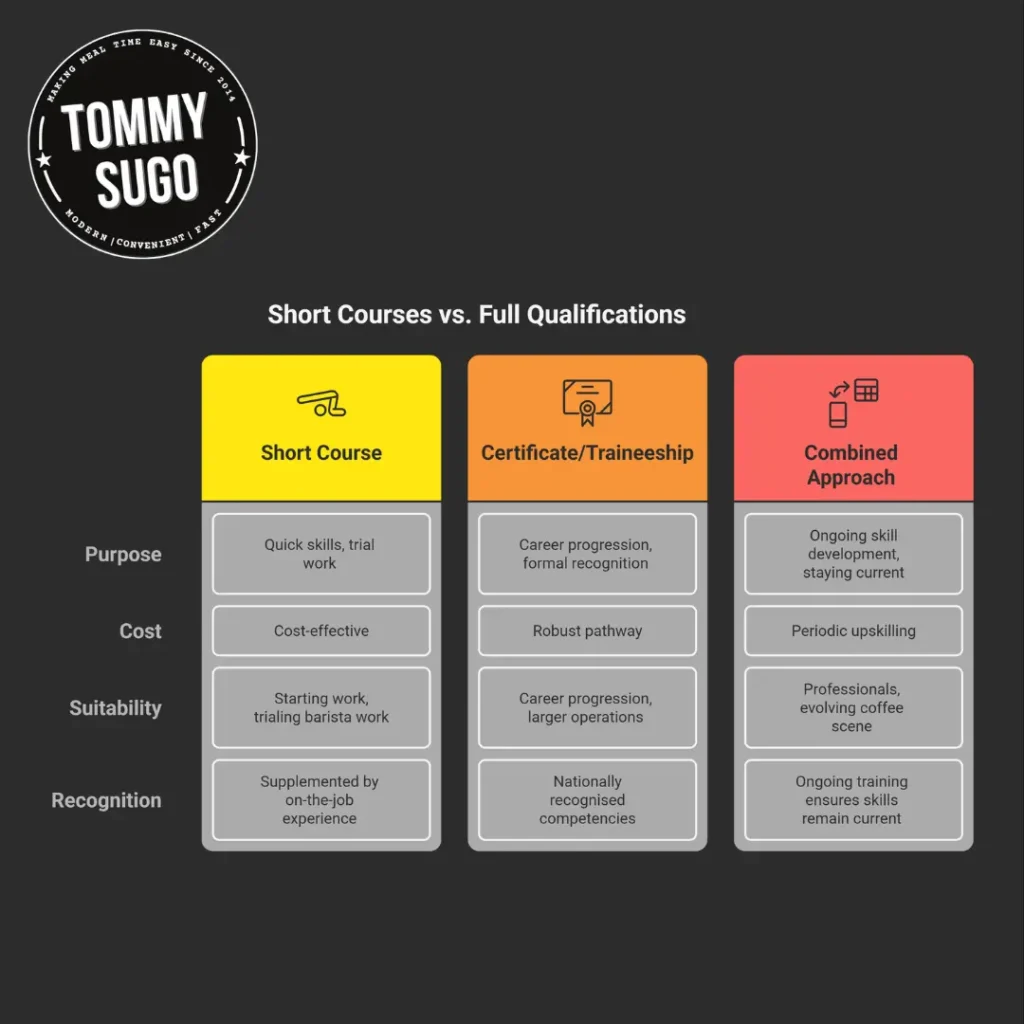
Choosing Between Short Courses and Full Qualifications
When a short barista workshop is appropriate
If you need quick, practical skills to start work or want to trial barista work, a short course provides a cost-effective introduction. For many cafes in Perth, a short course supplemented by on-the-job experience is sufficient.
When to invest in a certificate or traineeship
If you seek career progression, formal recognition or intend to work in larger hospitality operations, a Certificate III or traineeship offers a robust pathway. Employers often prefer candidates with nationally recognised competencies obtained through a comprehensive barista course Perth.
Combining short courses with ongoing upskilling
Many professionals combine initial short courses with periodic upskilling in latte art, sensory analysis or roastery practices. Ongoing training ensures skills remain current in Perth’s evolving coffee scene.
What to Expect on Your First Day of Training
Orientation and safety briefings
You will typically receive an orientation covering workplace health and safety, food handling and course expectations. A barista course Perth prioritises safe equipment operation and hygiene standards.
Hands-on machine time
Expect immediate practical exposure to commercial espresso machines and grinders. Trainers guide basic set-up, group head cleaning and an introduction to espresso extraction.
Assessment scheduling and documentation
Understand how assessments are scheduled, what evidence you need to collect and how feedback will be delivered. A clear assessment plan is a hallmark of a quality barista course Perth.
Hiring a Trained Barista or Training Staff
Interview questions to assess skills
Ask candidates about extraction variables, milk texturing technique and cleaning routines. Practical tests during short shifts can reveal competence more reliably than verbal answers alone.
Onboarding and skill verification
Use a checklist derived from course competencies to verify skills during your staff onboarding. A staff member with a barista course Perth certificate should demonstrate the ability to produce consistent beverages under supervision.
Investing in staff development
Regular training improves service quality, reduces equipment misuse and increases staff retention. Consider partnerships with local training providers for tailored barista course Perth delivery at your cafe.
Local Providers and How to Compare Them
Registered training organisations and TAFE
Search the national register for RTOs and check TAFE Western Australia for hospitality and barista units. Confirm course outcomes and whether they deliver nationally recognised qualifications relevant to a barista course Perth.
Independent specialty coffee schools and roaster-led courses
Specialty coffee schools and local roasteries in Perth may offer focused, industry-led training. These often emphasise sensory skills and specialty brewing beyond basic cafe training.
Employer-run in-house training
Many Perth cafes run bespoke in-house training tailored to their menu and equipment. This practical model is effective for consistent service standards and is a common form of a barista course Perth for employees.
Legal, Health and Safety Considerations
Food handling and hygiene requirements
Baristas must understand food safety and hygiene standards. Courses usually include food handling units and practical demonstrations to comply with WA Health regulations.
Workplace health and safety around equipment
Handling steam wands, hot water and pressure systems involves risk. A quality barista course Perth covers safe machine operation and emergency procedures.
Alcohol service and licensing, where applicable
Some hospitality roles require a Responsible Service of alcohol (RSA) certification. If your role includes alcohol service in a cafe setting, ensure you hold the appropriate certification in addition to barista training.
Conclusion
Selecting the right barista course Perth depends on your goals: rapid practical skills, nationally recognised qualifications or specialised knowledge for the specialty coffee sector. Practical, competency-based training that balances hands-on machine time with coffee theory and workplace safety will best prepare you for entry-level roles and career progression. For cafe owners, investing in staff training improves service quality and operational efficiency. Evaluate providers on trainer experience, practical hours, assessment rigour and whether qualifications meet your employment or business needs.
If you are ready to start, compare local RTOs, TAFE courses and specialty coffee schools in Perth, request course outlines and practical schedules, and book an introductory workshop to experience training firsthand. Investing in a quality barista course Perth is a practical step toward a sustainable career in Western Australia’s thriving coffee industry.
Frequently Asked Questions
What is the typical duration of a barista course Perth?
Short workshops and beginner courses typically run 3–8 hours (half-day to full day); accredited skill sets or intensive programs last 3 days to several weeks; longer certificate/traineeship pathways can extend to months or a year.
Do I need prior experience to enrol?
Most beginner and basic courses welcome complete novices; accredited options may require basic literacy/numeracy for assessments, but no coffee experience is needed.
Will a short course get me a job?
Yes, short courses build practical, job-ready skills and confidence for entry-level roles; many employers value them, though combining with on-the-job experience or a nationally recognised unit boosts long-term prospects in Perth’s cafes.
Are barista courses in Perth nationally recognised?
Accredited courses from RTOs (e.g., SITHFAB025 Prepare and serve espresso coffee) provide a nationally recognised Statement of Attainment; short non-accredited workshops issue a Certificate of Participation check the provider’s RTO status.
How much does a barista course Perth cost?
Short beginner workshops range from AUD 120–260 (3–6 hours); accredited 5-hour or full-day courses cost AUD 149–199; multi-day skill sets or bundles can reach AUD 300–900. Some TAFE options offer low-fee/subsidised rates for eligible WA residents.
Can employers sponsor barista training?
Yes, many Perth cafés and hospitality venues sponsor employees via in-house sessions, RTO courses, traineeships, or apprenticeships; some access Jobs and Skills WA incentives or subsidies.
What skills beyond coffee-making are taught?
Courses often include customer service, food hygiene/safety (e.g., SITXFSA005), workplace health/safety, equipment cleaning/maintenance, basic café operations, stock handling, and teamwork.
How important is latte art training?
Latte art enhances drink presentation and customer appeal but ranks secondary to core skills like consistent espresso extraction and milk texturing; most comprehensive Perth courses include basic to intermediate latte art modules.
Are there pathways beyond barista roles?
Yes, progress to supervisory/team leader positions, specialty coffee roles (e.g., roasting, cupping), equipment maintenance, café management, or broader hospitality qualifications like Certificate III in Hospitality.
How do I verify a provider’s claims?
Confirm RTO registration on training.gov.au, request detailed course outlines/unit codes, check trainer qualifications/experience, read recent student reviews, and verify if nationally recognised outcomes are issued for job-relevant units.