
Introduction
Training as a barista in Perth opens pathways into cafes, hospitality management, coffee roastery roles, and small-business ownership. A Perth barista course can provide the technical skills, workplace knowledge, and recognised qualifications employers value. This article outlines course structures, certification options, costs, expected outcomes, and industry trends across Western Australia. The aim is to give practical, unbiased guidance so you can choose the right course and plan your career.
Key takeaways
- Types of training: short skills workshops, nationally recognised certificates, and bespoke employer programs.
- Core skills: espresso extraction, milk steaming, coffee hygiene, customer service, and equipment maintenance.
- Costs & duration: range from half-day workshops to 12+ week certificate courses with varying fees.
- Certifications: Statement of Attainment vs. Cert II/III in Hospitality, know which employers prefer which credential.
- Job outcomes: barista, café supervisor, roastery assistant, events barista, and coffee trainer roles are common.
- Industry trends: speciality coffee growth, sustainability, and coffee-tech integration in Perth.
What is a Perth barista course?
Definition and purpose
A Perth barista course teaches the skills required to operate commercial espresso equipment, prepare a range of coffee drinks to industry standards, and provide excellent customer service. Courses vary from short introductory sessions to nationally recognised vocational qualifications. The purpose is to prepare participants for immediate café work and longer-term hospitality careers.
Who it’s for
Typical participants include aspiring baristas, hospitality staff seeking upskilling, students, career changers, cafe owners, and managers who want to standardise service in their venues. Training suits those aiming for entry-level roles and those targeting supervisory positions with additional units.
Expected outcomes
After completing a Perth barista course, you should be able to extract consistent espresso shots, steam milk correctly for latte art basics, maintain espresso equipment, follow food safety protocols, and deliver professional customer interactions. More advanced courses add inventory management and supervisory skills.
Types of Perth barista courses available
Short workshops and introductory courses
Short workshops typically last from a few hours to a couple of days. They focus on hands-on skills: dosing, tamping, extraction, milk texturing, and basic machine cleaning. These are suitable for hobbyists and people seeking quick workplace-readiness.
Vocational certificates (Cert II and Cert III)
Nationally recognised qualifications such as Certificate II or III in Hospitality include barista units integrated with broader hospitality skills: food handling, service, workplace safety, and basic supervision. These courses run from several weeks to a few months and are often delivered by TAFE, Registered Training Organisations (RTOs), and colleges across Perth.
Specialist and advanced programs
Advanced programs include latte art masterclasses, sensory training, roasting fundamentals, and barista trainer qualifications. These are aimed at those seeking a career in specialty coffee, roastery operations, or training roles within larger hospitality groups.
Course structure and curriculum
Core technical skills
Core modules cover machine components, grinder setup, dosing, extraction time, yield ratios, milk temperature and texture, drink assembly, and presentation. Emphasis is placed on consistent extraction and repeatable quality.
Hygiene, safety, and customer service
Training includes food safety (e.g., Food Handler certification), cleaning schedules, safe manual handling, and customer service fundamentals. Courses ensure learners meet legal hygiene requirements for working in Perth cafes.
Assessment methods and practical hours
Assessment typically combines observed practical tasks, written knowledge checks, and workplace simulation. Nationally recognised courses require specified practical hours and competency-based assessments to issue Statements of Attainment or full certificates.
Certifications and recognition
Statement of Attainment vs full certificates
A short Perth barista course often issues a Statement of Attainment for specific units of competency, while full qualifications like Cert II/III are awarded after completing all required units. Statements are useful for targeted skills; full certificates are more valued by employers seeking broader hospitality capability.
Registered Training Organisations (RTOs) and quality assurance
Choose courses delivered by RTOs or TAFE to ensure nationally recognised qualifications. RTOs are audited by the Australian Skills Quality Authority (ASQA), offering assurance on training standards and credential validity across Australia, including Western Australia.
Industry-recognised endorsements and coffee associations
Some providers partner with roasters or coffee associations to provide industry-endorsed training. While not a substitute for national credentials, these endorsements can signal specialist knowledge in specialty coffee and local industry connections.
Costs and duration
Typical price ranges
Perth barista course costs vary: short workshops can cost from AU$80–$250, mid-level courses AU$300–$900, and full certificate courses AU$1,200–$4,000, depending on provider, duration, and inclusion of materials. Specialist programs such as roasting or sensory courses can cost more.
Time commitment and scheduling
Short workshops: half-day to two days. Certificate courses: several weeks of classroom and practical training plus workplace experience. Part-time and weekend options are common to accommodate students and working professionals.
Funding, subsidies, and concessions
Check state government subsidised training and any concession rates for students or job-seekers. Some employers sponsor staff through courses or reimburse fees if tied to employment contracts. RTOs may offer payment plans to spread costs.
Skills covered in a Perth barista course
Technical coffee skills
Technical skills include understanding coffee origins, grind adjustment, dosing, tamping, shot extraction, milk texturing, beverage recipes, and equipment troubleshooting. Courses teach consistency, sensory evaluation, and basic latte art techniques.
Customer service and upselling
Effective service training covers greeting customers, recommending products, managing orders, suggesting food pairing, and upselling while maintaining service speed. Scenario-based training helps develop confidence in busy settings.
Operational and business skills
More comprehensive courses include inventory management, stock rotation, cost control, rostering basics, and workplace communication. These skills are especially relevant for supervisors and café owners.
Choosing the right Perth barista course provider
What to look for in a provider
Select providers with experienced trainers, up-to-date equipment, strong industry links, and clear assessment methods. Inspect class sizes, hands-on time per participant, and whether training occurs in a real café environment or simulated classroom.
Comparing course content and outcomes
Compare unit lists, assessment approaches, credential type (Statement vs Certificate), and whether the course includes work placement or job-ready modules. Read course outlines carefully to ensure alignment with career goals.
Locations and delivery modes in Perth
Perth offers courses across metropolitan locations, including the CBD, northern and southern suburbs, and regional outreach. Delivery modes include face-to-face, blended learning with online theory and on-site practical sessions, and employer-delivered in-house training.
Job outcomes and career pathways in Perth
Immediate roles after training
Graduates often secure roles as baristas, café assistants, or front-of-house staff. Many employers prioritise hands-on experience, so combining training with casual shifts or internships improves job prospects.
Progression to supervisory and specialty roles
With experience and further training, baristas can progress to shift supervisor, café manager, roastery technician, wholesale coffee representative, or events barista. Supervisory units in certificate courses support this progression.
Longer-term career opportunities
Longer-term options include starting a café, working in hospitality management, becoming a coffee trainer, or moving into coffee importation, quality control, and specialty roasting. Perth’s evolving coffee scene supports diverse roles.
Industry trends and the Perth coffee market
Growth of specialty coffee in Western Australia
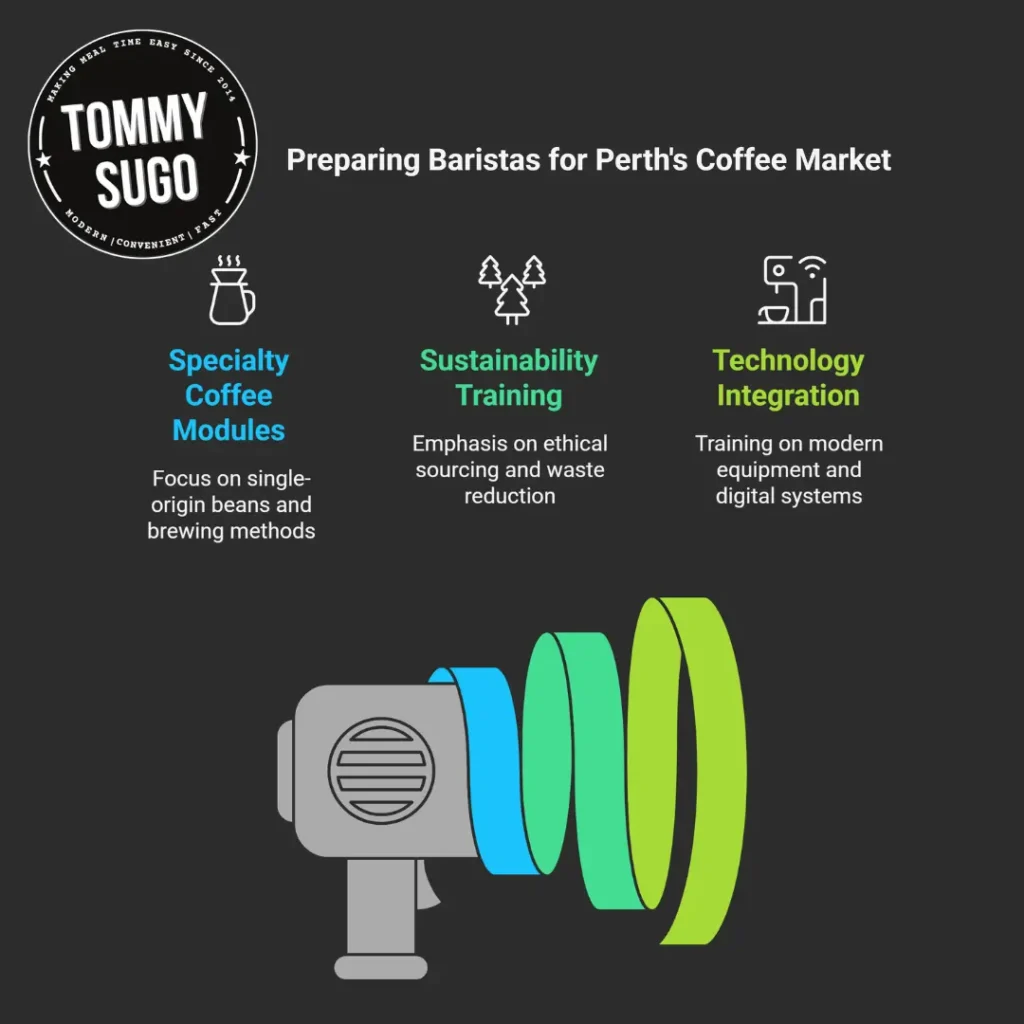
Perth has seen steady growth in specialty coffee, with an emphasis on single-origin beans, alternative brewing methods, and small-batch roasters. A Perth barista course that includes specialty coffee modules better prepares candidates for these roles.
Sustainability and ethical sourcing
Cafes increasingly prioritise sustainable practices: compostable packaging, ethical sourcing, direct trade relationships, and waste reduction. Training on sustainability helps baristas contribute to business values and customer expectations.
Technology and automation
Technology affects workflow through app ordering, bean-to-cup machines, and automated grinders. Courses that cover modern equipment and digital point-of-sale systems give trainees an advantage in technologically progressive venues.
Practical tips for success in a Perth barista course
Prepare before your course
Read course materials in advance, practise basic milk steaming and espresso tasting if possible, and familiarise yourself with local coffee terminology. Bring a notebook and be ready for hands-on practice.
Maximise hands-on learning
Prioritise providers that guarantee ample machine time. Ask for feedback, request video demonstrations, and rehearse service scenarios. Real-world exposure accelerates skill acquisition.
Build a professional portfolio
Document your progress with photos of latte art, notes on extraction parameters, and feedback from trainers. A simple portfolio or digital profile showcasing skills and certifications helps when applying for roles.
Costs vs benefits: Is a Perth barista course worth it?
Short-term benefits
Short courses quickly build practical skills, increase employability, and can be affordable. If you need to enter the workforce quickly, a focused Perth barista course is beneficial.
Long-term value
A full certificate offers broader hospitality skills and formal recognition that can support career progression. Investment in higher-level training often pays off through better job stability and advancement opportunities.
Alternative learning paths
On-the-job training, apprenticeships, and mentorship with experienced baristas are alternatives or complements to formal courses. Combining structured training with workplace experience is frequently the best approach.
How to apply and enrol in a Perth barista course
Research and shortlist providers
Begin with local RTOs, TAFEs, and reputable specialty coffee trainers. Read reviews, inspect facilities if possible, and confirm the number of practical hours and assessment criteria.
Enrolment requirements
Most courses have minimal entry requirements; some may require a food safety card or baseline language skills. Check identification requirements and any pre-course tasks the provider requires.
Preparing for the first day
Bring comfortable clothing, closed shoes, a pen, and adherence to hygiene protocols. Be punctual, prepared to engage in group work, and ready for physical, hands-on learning.
Conclusion
A Perth barista course can be a practical route into the hospitality and specialty coffee industry in Western Australia. Options range from short workshops to nationally recognised certificates. Consider your career goals, available time, and budget when choosing a course. Look for recognised providers, strong practical components, and industry links to maximise job outcomes. Stay aware of industry trends, specialty coffee, sustainability, and technology, which are shaping demand.
If you are ready to start, research local RTOs and specialty coffee trainers in Perth, compare course contents and enrolment dates, and book a hands-on workshop to test your interest. Pair formal training with workplace shifts to accelerate employment.
Ready to level up your coffee skills?
Connect with us to book your place or ask questions. We’re here to help you find the right Perth barista course for your goals.
Connect with us now at tommysugo.com.au
Frequently Asked Questions
Who should take a Perth barista course?
Anyone wanting practical coffee-making skills, from beginners to hospitality staff seeking upskilling. The course covers essential techniques like dosing, tamping, extraction, and steaming. It’s tailored to real workplace tasks to make you job-ready and confident.
How long is the typical course?
Most Perth barista courses run between one day (introductory) and several weeks for comprehensive certification. Short courses focus on core practical skills while longer programs include theory and workplace competencies. Choose a duration based on your current skill level and career goals.
Do I need prior experience?
No prior experience is required for beginner-friendly Perth barista course options. Advanced modules are available if you already know basic espresso and steaming techniques. Instructors adapt teaching to individual skill levels during practical sessions.
What will I learn during the course?
You’ll learn espresso extraction, milk texturing, machine operation, cleaning, and coffee knowledge. Courses also cover customer service, speed techniques, and basic latte art to improve cafe performance. Assessment typically includes practical demonstrations and short theory checks.
Is certification provided?
Many Perth barista courses offer a certificate of completion; some provide nationally recognised credentials. Verify with the training provider whether the award is nationally accredited or a proprietary certificate.
What equipment is used in training?
Training uses commercial espresso machines, grinders, and steaming pitchers to mirror real café setups. Hands-on practice with industry-standard equipment ensures skills transfer to workplace machines. Providers often maintain small class sizes so each student gets equipment time and instructor feedback.
How much does a Perth barista course cost?
Costs vary widely from budget one-day workshops to comprehensive multi-week programs with higher fees. Price depends on course length, accreditation, equipment access, and inclusion of take-home materials. Check the provider’s website or contact them directly for current pricing and any payment options.
Will the course help me get a job?
A Perth barista course builds practical skills employers look for and can improve your employability in cafes. Some providers offer job placement support, resume help, or links to local employers in hospitality. Combining certification with on-the-job experience gives you the best chance of landing work.
Can I improve my latte art?
Yes, many courses include dedicated latte art modules teaching milk texture, pouring technique, and designs. Progression from basic hearts to rosettas is covered with guided practice and constructive feedback. Regular practice after class accelerates skill development and consistency.
How do I book or ask more questions?
Visit our site and connect with us to check course dates, availability, and tailored recommendations. We’ll help you choose the right Perth barista course based on experience, schedule, and career aims. Start now by contacting us at tommysugo.com.au.